
Tari (XTM): what it is and how it is mined on ASICs, GPUs and CPUs
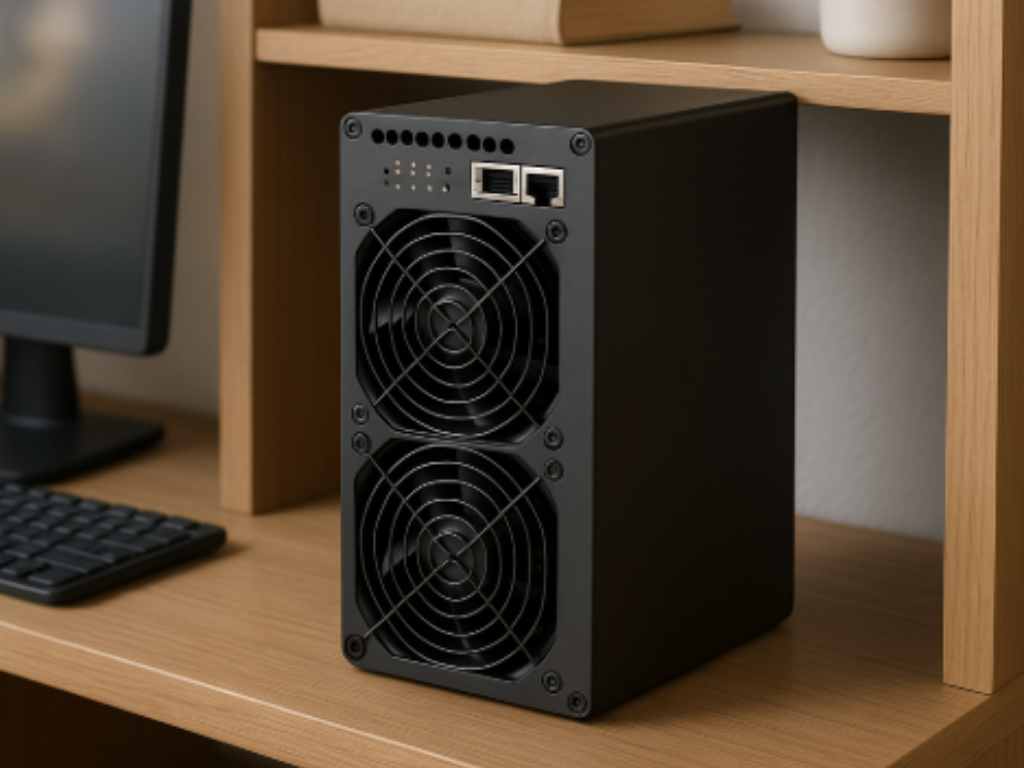
Tari (XTM) is a cryptocurrency that can be mined in four different ways at once: on a processor (RandomX, also together with Monero), on a graphics card (Cuckaroo29) and on ASIC miners (SHA3x). Each of these “lanes” receives a quarter of the blocks, so no single type of hardware can take over the network. For ASIC owners, the quiet Goldshell XT-BOX is the main point of interest: as of 18 Oct 2026, it mines about CZK 74 a day gross at a power draw of 400 W.
Summary
- The Tari mainnet (the Minotari layer) has been running since 6 May 2025.
- Since the fork at block 95,000 in September 2025, the network has had four mining lanes of 25% each: RandomX with Monero, standalone RandomX, Cuckaroo29 and SHA3x.
- A block is created on average every 2 minutes and carries roughly 10,000 XTM. The maximum supply is 21 billion XTM; after about 28 years, a permanent 1% annual emission will follow.
- The XTM exchange rate is very low (around USD 0.0013 as of 18 Oct 2026), so earnings are counted in thousands of coins a day.
What Tari is and what it is for
Tari is a blockchain focused on privacy, payments and digital assets. The base layer, Minotari, is mined with Proof of Work and handles payments. On top of it, a second layer for managing digital assets and smart transactions is being built.
Fixed emission rules are set for a long period. Of the maximum 21 billion XTM, 70% goes to miners and 30% was created in advance (community, infrastructure and grants, contributors and participants), released gradually. The block reward falls exponentially for about 27.8 years, then switches to a permanent emission of 1% a year.
How Tari is mined: four algorithms, four lanes
Most coins have a single algorithm and a single type of machine that eventually dominates the network. Tari does it differently: each algorithm has its own difficulty and a guaranteed share of blocks. A network-wide block is created on average once every 120 seconds, so within a single lane roughly once every 8 minutes.
| Lane | Algorithm | Hardware | Share of blocks |
|---|---|---|---|
| Merge mining with Monero | RandomX | processor (CPU) | 25% |
| Standalone RandomX | RandomX | processor (CPU) | 25% |
| GPU lane | Cuckaroo29 (C29) | graphics card with 7 GB VRAM or more | 25% |
| ASIC lane | SHA3x | ASIC, e.g. Goldshell XT-BOX | 25% |
The network did not look like this from the start. After launch, hashrate was split in half between RandomX and SHA3. The fork at block 15,000 (26 May 2025) introduced a split into thirds, and the fork at block 95,000 in September 2025 added a fourth, graphics lane, Cuckaroo29. So the mining rules changed twice in the first five months.
Merge mining with Monero
Anyone mining Monero on a processor can also earn XTM at the same time via merge mining. The processor does the same work for both networks, so Tari comes “on top” with no extra consumption. We discuss why miners are taking an interest in Monero again in 2026 in our article Zcash and Monero vs Bitcoin.
SHA3x and the arrival of ASICs
SHA3x is a variant of the SHA-3 function that was initially computed mainly by graphics cards. In October 2025, the first ASIC miner for this algorithm, the Goldshell XT-BOX, arrived, and graphics cards stopped paying off in this lane. In February 2026, the official Tari Universe app removed SHA3 mining on GPUs entirely and now sends cards to the Cuckaroo29 lane.
How much Tari mining earns today
We don't have live data for Tari, so we give a calculation as of 18 Oct 2026. According to Kryptex, a Goldshell XT-BOX (580 GH/s) mines about 2,535 XTM a day, roughly USD 3.42. The XTM exchange rate is USD 0.00135, USD 1 ≈ CZK 21.5.
| Item | At home (CZK 5/kWh) | Hosting (CZK 1.13/kWh) |
|---|---|---|
| Gross earnings per day | 2,535 XTM ≈ CZK 74 | 2,535 XTM ≈ CZK 74 |
| Consumption per day (400 W × 24 h) | 9.6 kWh = CZK 48 | 9.6 kWh = CZK 11 |
| Remaining before pool fee | ≈ CZK 26 | ≈ CZK 63 |
For comparison: on the same day, ASIC Miner Value gives earnings of USD 3.31 and, at USD 0.10/kWh electricity, a profit of USD 2.35 a day. The XT-BOX is therefore one of the few small quiet machines that can cover even typical Czech electricity prices today. The margin isn't large, though: a one-third drop in the exchange rate would wipe out the profit at the household tariff.
In the other lanes, earnings depend on the specific processor or card. With merge mining alongside Monero, it is a small bonus on top of XMR earnings. Work out the earnings of a graphics card in the C29 lane with the pool's calculator for your specific model and electricity price – we write about cards for mining in general in our article Which cards are suitable for mining.
Goldshell XT-BOX: specifications of the ASIC miner for Tari
| Parameter | Value |
|---|---|
| Algorithm | SHA3x (Tari) |
| Hashrate | 580 GH/s ±5% |
| Power | 400 W ±5% |
| Efficiency | 0.69 J/GH |
| Noise | around 35 dB |
| Launch | October 2025 |
35 dB of noise corresponds to a quiet room, so the XT-BOX can stand in a flat or office and plugs into a normal socket. Just bear in mind that the machine can only run one algorithm. If Tari changed the rules or the share of the SHA3x lane, the XT-BOX would have nowhere else to go. If you are looking for a quiet machine for established coins, take a look at our miners for home mining.
Pools and wallets for Tari
You get a wallet in the Tari Universe desktop app, which can also mine on the processor and graphics card. For phones there is a mobile wallet for Android and iOS. XTM trades, for example, on the MEXC exchange.
ASICs and powerful cards connect to a pool. Kryptex, for example, has separate pools for SHA3x, Cuckaroo29 and RandomX. For SHA3x it charges a 1% fee in both PROP and SOLO mode and pays out from 200 XTM. The default pool in the Tari Universe app is LuckyPool.
- Create a wallet in Tari Universe or in the mobile app and back up the recovery words offline.
- Connect the XT-BOX to your router with a cable and open its IP address in a browser.
- Enter the stratum address of a SHA3x pool, your XTM address as the user and the machine name after a dot.
- After 20–30 minutes, check on the pool's page that the hashrate is roughly 580 GH/s.
Risks of mining Tari
- Changing rules. In the first year there were two forks that changed how blocks are divided. Another change could raise or lower ASIC lane earnings.
- High emission at the start. The exponential curve means the most new coins in the first years. Together with the release of the pre-created 30%, this puts pressure on the exchange rate.
- Exchange rate and liquidity. At a price of fractions of a cent, the rate easily moves by tens of per cent. There are still few exchanges with sufficient volume.
- A single ASIC manufacturer. The SHA3x lane currently relies mainly on Goldshell machines. A new, more efficient model would quickly reduce the earnings of older units.
Tari is an interesting attempt at a fairer split of mining between processors, cards and ASICs. As with any young coin, however, bear in mind that today's earnings are no guarantee of tomorrow's.
What next
- ASIC miner profitability – a live comparison of machines for Bitcoin, Kaspa, Litecoin and other established coins, recalculated every hour.
- Quiet miners for home mining – alternatives to the XT-BOX for the flat and office.
- ASIC miner hosting – with electricity from 1,13 Kč/kWh, the gap between earnings and costs widens significantly.
Sources
Frequently asked questions
Can I mine Tari and Monero at the same time?
What graphics card do I need for Tari?
Is the Goldshell XT-BOX suitable for a flat?
Where can I sell mined XTM?
Why do people talk about mining lanes?
This text was prepared with the help of AI. Facts, figures and procedures were checked by Yegor.


