Bitcoin SV (BSV): what it is and whether mining it pays off

Bitcoin SV (BSV) is an offshoot of Bitcoin Cash, created on 15 November 2018, with no block size limit at all. SV stands for “Satoshi Vision” – its supporters claim it is Bitcoin as its author originally envisaged it. It is mined with the same SHA-256 miners as Bitcoin, but today it earns the least of the four main SHA-256 coins: about 0,68 Kč per 1 TH/s a day.
Summary
- BSV was created by a split of Bitcoin Cash in 2018. Its main figurehead was Craig Wright – about whom a British court ruled in 2024 that he is not Satoshi Nakamoto.
- Issuance is the same as Bitcoin's: 21 million coins, 10-minute blocks, and since April 2024 a reward of 3.125 BSV.
- The network hashrate is only around 0.25 EH/s. A single modern machine accounts for roughly a tenth of a per cent of the network.
- The coin has lower liquidity, some big exchanges have delisted it, and in 2021 the network suffered 51% attacks.
What Bitcoin SV is and where it came from
In November 2018 Bitcoin Cash split into two camps. Most of the community, including the Bitcoin ABC developers, stayed with Bitcoin Cash; the other camp was led by Craig Wright and the entrepreneur Calvin Ayre. The dispute concerned block size as well as other protocol changes. From block 556,766 BSV has run as a separate network.
BSV is built on the idea that Bitcoin should scale with huge blocks directly on the blockchain. The Genesis upgrade in February 2020 (block 620,538) removed the block size limit entirely. According to the BSV Association, the network has already processed blocks of up to 4 GB.
In April 2026 the mandatory Chronicle upgrade was scheduled at block 943,816. It restores original instructions from the first versions of Bitcoin to the scripting language and relaxes some rules for new transaction types. For miners it mainly means that the pool must run on an updated node. In future, the current node is to be replaced by the new Teranode architecture, which handled over a million transactions per second on the test network.
Controversy around BSV
For years Craig Wright claimed to be Satoshi Nakamoto. In March 2024 the High Court in London ruled, in a case brought by the COPA organisation, that he is not. Even before that, BSV was delisted by Binance in April 2019, and Coinbase halted BSV trading in 2021 and ended support entirely in January 2024. From June to August 2021 the network suffered several 51% attacks, in which the attacker rewrote recent blocks.
| Parameter | Bitcoin SV |
|---|---|
| Ticker | BSV |
| Created | 15 November 2018 (split from Bitcoin Cash) |
| Algorithm | SHA-256, proof of work |
| Target block time | 10 minutes |
| Block reward | 3.125 BSV (since April 2024) |
| Maximum supply | 21,000,000 BSV |
| Block size limit | none (since the Genesis upgrade, 2020) |
| Network hashrate | 230–280 PH/s, i.e. around 0.25 EH/s (as of 18 October 2026) |
| Price | 390 Kč |
How BSV is mined and how much it earns
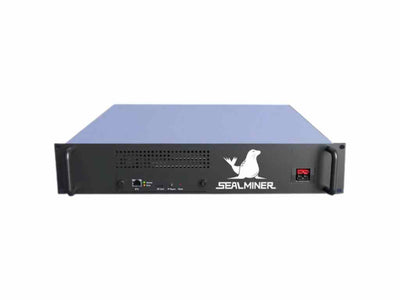
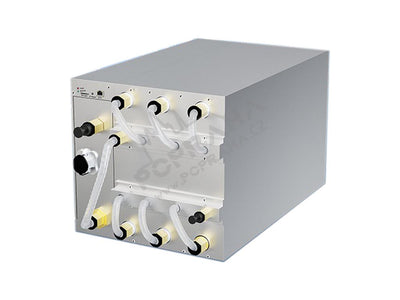
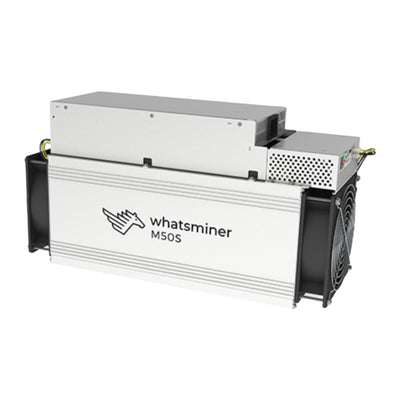
Technically BSV is mined just like Bitcoin: the same ASIC miner, the same firmware, a different pool address. The halving took place in April 2024 at block 840,000, when the reward fell from 6.25 to 3.125 BSV.
At today's difficulty and exchange rate, 1 TH/s earns about 0,68 Kč a day, compared with 0,84 Kč on Bitcoin. An Antminer S21++ with 235 TH/s would thus mine around CZK 160 a day on BSV instead of CZK 197 on BTC (as of 18 October 2026, gross). Electricity is the same: about 90 kWh a day, i.e. CZK 102 in hosting at CZK 1.13/kWh.
More interesting is the size of the network. At a hashrate of 230–280 PH/s, one S21++ makes up about 0.1% of the network. Solo mining, it would statistically find a whole block roughly once every 7–8 days. That is only an average, though – a block may come in a day or in a month, and the value of the reward depends on the price, which fluctuates sharply for BSV.
Pools and wallets
Only a small number of pools mine BSV, for example GorillaPool or Kryptex Pool. Before redirecting your hashrate, check the pool's current fee, minimum payout and whether it still supports BSV – the choice has narrowed in recent years.
Choose a wallet according to whether it explicitly supports BSV. BSV addresses have the same format as older Bitcoin and Bitcoin Cash addresses (starting with 1). Sending a coin to an address on a different network is easy, and getting it back tends to be difficult.
Risks of mining BSV
- The lowest earnings of the four main SHA-256 coins – for the same electricity you get roughly a fifth less than on Bitcoin.
- Liquidity. After delistings from some big exchanges, selling a larger amount can be difficult.
- A small network. A hashrate of around 0.25 EH/s is a fraction of Bitcoin's. The history of 51% attacks shows this is not just a theoretical risk.
- Reputation. The disputes around Craig Wright and the 2024 court ruling affect the interest of exchanges and investors.
Who mining BSV makes sense for
For an ordinary miner, Bitcoin or Bitcoin Cash is the better choice. BSV may interest those who believe in the project, want to hold the coins or are trying solo mining with one machine in a small network. The machines are universal – you can switch a miner from the BSV network back to BTC at any time.
What next
- SHA-256 coins – a comparison of BTC, BCH, BSV and eCash, including the chance of a solo block.
- Bitcoin mining: does it pay off today? – the electricity calculation, profitability threshold and hosting apply equally to BSV.
- SHA-256 miners – machines that mine both Bitcoin and BSV.
Sources
Frequently asked questions
What does SV stand for?
Is BSV the same as Bitcoin Cash?
Where can I sell mined BSV?
Why does BSV earn less than Bitcoin?
This text was prepared with the help of AI. Facts, figures and procedures were checked by Yegor.