Handshake (HNS): what it is, how it's mined and is it worth it today
Handshake (HNS) is a cryptocurrency for decentralised domain names: instead of relying on the administrator of the internet's root zone, people bid for top-level domains (TLDs) on a blockchain. It is mined on ASIC miners using the Blake2B-SHA3 algorithm, a block is found roughly every 10 minutes and the miner currently receives 500 HNS for it. The yield, however, is very low: 0,0069 Kč per 1 GH/s per day, so in Czechia mining Handshake does not pay off today, either at home or on hosting.
Summary
- Handshake has been running since 3 February 2020. Whoever wins the auction for a name such as .mycompany owns it directly on the blockchain, with no need for ICANN or a registrar.
- The reward drops through halvings every 170,000 blocks. The second halving took place on 27 July 2026 (block 340,000), cutting the reward from 1,000 to 500 HNS.
- As of 12 November 2026, a Goldshell HS Box II home miner (460 GH/s, 400 W) earns about 3.2 Kč a day, but electricity at 4.5 Kč/kWh costs 43 Kč.
- The same machine can switch to the Blake2b-Sia algorithm (Siacoin, BTCB2), where it currently performs considerably better.
- Risks: a very small market, Namecheap's withdrawal from Handshake in 2026 and the concentration of hashrate in a single pool.
What Handshake is and what it is for
When you type an address into your browser, your computer asks the DNS system where the website is located. At the top of DNS sits the root zone, managed by ICANN. ICANN decides which endings, such as .cz or .com, exist at all. A new ending costs hundreds of thousands of dollars and takes years to approve.
Handshake records this root zone on its own blockchain. A top-level name goes to whoever wins it in a so-called Vickrey auction. Bids are hidden at first, the winner pays the amount of the second-highest bid and the winning HNS are "burned". The owner then manages the name with their private key, much like coins in a wallet.
The catch is support. An ordinary browser will not open Handshake names without modification. You need a browser with Handshake integration or a DNS resolver that can resolve names from the blockchain. That is why Handshake remains more of an enthusiasts' project than a replacement for ordinary domains.
The HNS coin and supply distribution
The maximum supply was set at 2.04 billion HNS. The creators allocated a large share to an airdrop for open-source software developers. In August 2025 the network cancelled the unclaimed allocations (890 million HNS) through the Airstop soft fork, so the actual supply will be considerably lower. The project's founders raised USD 10.2 million from investors and donated the entire amount to the open-source community.
How Handshake is mined: algorithm, block and reward
| Parameter | Handshake (HNS) |
| Algorithm | Blake2B-SHA3 (a combination of the BLAKE2b and SHA-3 hashes) |
| Target block time | 10 minutes (actually around 9–12 minutes as of 12 November 2026) |
| Block reward | 500 HNS (since 27 July 2026) |
| Halving | every 170,000 blocks, roughly 3.2 years; the next one at block 510,000 (around 2029) |
| Maximum supply | 2.04 billion HNS, minus the cancelled airdrop allocations |
| Network hashrate as of 12 November 2026 | approx. 390–650 TH/s depending on the source (WhatToMine, our data) |
| Price as of 12 November 2026 | 0,0499 Kč per 1 HNS |
The reward history is simple: until April 2023 it was 2,000 HNS per block, the first halving at block 170,000 (28 April 2023) reduced it to 1,000 HNS and the second at block 340,000 (27 July 2026) to today's 500 HNS. We explain how halving works using Bitcoin as an example in the article Bitcoin halving.
The entire network currently mines around 79,500 HNS a day. At today's price, that is just under 4,000 Kč a day for all the miners in the world combined. Such a small "pie" explains why the yield of a single home machine comes to only a few crowns.
How much Handshake mining earns today
The current yield is 0,0069 Kč per 1 GH/s per day (calculated on 12. 11. 2026). Your machine's yield is its hashrate in GH/s multiplied by this figure. We track hashrate and difficulty on the Mining statistics page.
Our calculation as of 12 November 2026: 0.00692 Kč per 1 GH/s per day, excluding the pool fee. At home we assume 4.5 Kč/kWh; on hosting we use the cheapest location at 1,15 Kč/kWh.
| Miner | Hashrate | Power draw | Yield Kč/day | At home: profit Kč/day | Hosting: profit Kč/day | Break-even point |
| Goldshell HS Box II | 460 GH/s | 400 W | 3.2 | −40.0 | −7.8 | 0.33 Kč/kWh |
| Antminer HS3 (legacy model) | 9 TH/s | 2,079 W | 62.3 | −162.2 | +5.2 | 1.25 Kč/kWh |
The table leads to a clear conclusion: no home machine makes money on Handshake today. Only the large Antminer HS3 on the cheapest hosting gets just above zero, and after deducting the pool fee the profit is only a few crowns a day. Such a thin margin disappears with the first drop in the HNS price. You can find a comparison with other coins on the ASIC miner profitability page.
A better use: switching the HS Box II to Blake2b-Sia
According to the manufacturer, the Goldshell HS Box II has two modes. Besides Handshake, it supports the Blake2b-Sia algorithm with a hashrate of around 1.2 TH/s at 325 W. This algorithm is used to mine Siacoin and, since September 2026, also BTCB2.
| HS Box II mode | Hashrate / power draw | Yield Kč/day | Electricity at home | Electricity on hosting |
| Handshake (HNS) | 460 GH/s / 400 W | 3.2 | 43.2 | 11.0 |
| Siacoin (SC) | 1.2 TH/s / 325 W | 26.7 | 35.1 | 8.9 |
| BTCB2 | 1.2 TH/s / 325 W | 66.5 | 35.1 | 8.9 |
Calculated as of 12 November 2026. With BTCB2, these are credited coins, not money in hand: new rewards are locked for roughly 180 days, see BTCB2 locked for 180 days. Check whether the pool accepts your specific model and firmware before switching. If you want to buy a machine for Handshake, it is sensible today to plan mainly around the Blake2b-Sia mode.
Which miner to use for Handshake
Handshake can only be mined on ASIC miners. Goldshell brought out the first Handshake machines, and in December 2022 Bitmain released the powerful Antminer HS3. Today the market mainly offers older models and, among the newer ones, the home-friendly Goldshell HS Box II from January 2024.
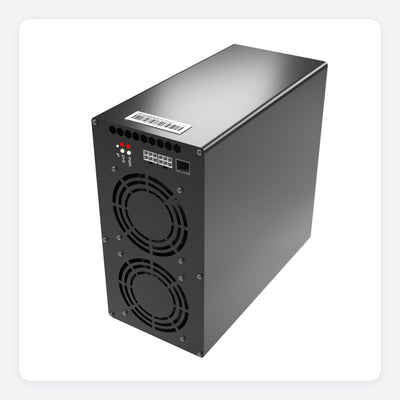
The HS Box II is small (about 2 kg) and quiet – the manufacturer states 35 dB – so it is suitable for a flat. Large machines such as the HS3 run at 75 dB and belong in a workshop or a data centre. You can find all machines for this algorithm in the Handshake miners collection.
How to get started: wallet, pool and setup
- Create an HNS wallet, for example Bob Wallet, or run an hsd full node. The address starts with hs1. Write your seed down on paper.
- Choose a pool that supports Handshake, for example Mining-Dutch. Check the fee and minimum payout directly with the pool; payout types are explained in the article PPS, PPLNS and FPPS.
- Connect the miner to the network and, in its web interface, enter the pool's stratum address, your wallet address as the worker name and the password as specified by the pool. The general procedure is described in the guide How to connect an ASIC miner.
- On the HS Box II, make sure the selected algorithm is Blake2B-SHA3, not Blake2b-Sia.
- After 10–15 minutes, check that the pool shows your hashrate and is accepting shares.
- Measure the power consumption with a wattmeter and compare it with the yield from the table above. If the result is negative, switch the machine to a more profitable algorithm or turn it off.
Risks of mining Handshake
- Small market: as of 12 November 2026 the market capitalisation of HNS was around USD 2 million, and it trades mainly on smaller exchanges. Larger volumes may not sell at the quoted price.
- Big players pulling out: in January 2026 the registrar Namecheap sold the Namebase marketplace, and on 10 June 2026 it stopped registering and renewing Handshake names. The ecosystem thereby lost its biggest gateway for ordinary users.
- Hashrate concentration: according to WhatToMine, as of 12 November 2026 roughly half of the tracked hashrate belongs to a single pool (Mining-Dutch). For the network, this poses a risk of blocks being rewritten.
- Halvings: every three years the reward is cut in half. Without a rise in price, the yield keeps falling.
- Price: the yield in crowns changes every hour with the exchange rate and the network hashrate. This is not investment advice and the yield is not guaranteed.
What next
- Handshake miners: Blake2B-SHA3 machines with a yield calculator.
- Siacoin (SC): a more profitable mode for the HS Box II and other Blake2b machines.
- ASIC miner hosting: operation at an industrial electricity price in our data centres.
Sources
- ShakeShift: block 340,000 (second halving, 27 July 2026)
- ShakeShift: Airstop soft fork (activated 28 August 2025)
- ViaBTC: first Handshake halving at block 170,000 (2023)
- Hey TX: HNS Over the Years (project history)
- Webhosting.today: Namecheap ends Handshake support (June 2026)
- ASIC Miner Value: Goldshell HS Box II, specifications for both modes
- WhatToMine: Handshake – network hashrate, reward and pools
Frequently asked questions
Is mining Handshake (HNS) worth it today?
Which miner is used to mine Handshake?
When was the Handshake halving?
Can the HS Box II mine other coins too?
What is Handshake good for?
This text was prepared with the help of AI. Facts, figures and procedures were checked by Yegor.