Monero (XMR): what it is, how it is mined and whether it pays off today
Monero (XMR) is a privacy-focused cryptocurrency: it hides the sender, the recipient and the amount of every transaction. It is mined with the RandomX algorithm, which is designed for ordinary processors, and a new block is produced roughly every 2 minutes. Today the yield is 0,79 Kč per 1 kH/s per day, so in the Czech Republic mining only pays off on server processors or with cheap electricity.
Summary
- Monero was launched in April 2014. Privacy is provided by ring signatures, stealth addresses and hidden amounts (RingCT), and it cannot be switched off.
- Since June 2022 there has been a tail emission of 0.6 XMR per block. Monero therefore has no fixed supply cap and no halvings.
- It is mined on the processor (CPU) with XMRig, solo or via the decentralised P2Pool. No suitable ASIC miner is on sale.
- At 4.5 Kč/kWh most home PCs make a loss. Energy-efficient Ryzens, Threadrippers and EPYCs are in profit.
- Risks: from 2027 crypto-asset service providers in the EU may not handle privacy coins. A major network upgrade (FCMP++ and RandomX v2) is also on the way, and in 2025 hashrate became concentrated with Qubic.
What Monero is and how it differs from Bitcoin
Bitcoin is transparent. Anyone can see how many coins went from which address to which address. Monero is built the other way round: every transaction is private by default and the user cannot turn this off. As a result every coin is identical and cannot be "tainted" because of its history (this is known as fungibility).
Monero was launched on 18 April 2014 by developers around the CryptoNote protocol. No company or foundation runs it; it is developed by the community. Like Bitcoin, it uses proof of work, meaning the network is secured by miners.
How the privacy works
| What is hidden | Technology | How it works, simply put |
| Sender | Ring signatures | Your input is mixed with 15 other inputs from the blockchain. From the outside you cannot tell which of the 16 is the real one. |
| Recipient | Stealth addresses | Every payment goes to a one-time address. Your public address never appears on the blockchain. |
| Amount | RingCT and Bulletproofs+ | Amounts are encrypted. The network still verifies that nobody has created coins out of thin air. |
Private does not mean unverifiable. Every node on the network checks that a transaction is valid and that coins are not spent twice. We explain how this works for Bitcoin and Kaspa in the article Why a transaction cannot be forged.
How Monero is mined: RandomX, blocks and rewards
RandomX has been Monero's mining algorithm since November 2019. For every attempt it generates a random program, which requires fast memory and a large processor cache. A specialised chip therefore has little advantage over a CPU, so anyone with a computer can mine.
- Block time: roughly 120 seconds.
- Reward: 0.6 XMR per block plus transaction fees. The main emission ended in June 2022 and the reward has not changed since.
- Emission: about 432 XMR per day (720 blocks × 0.6 XMR). That is just under 1% a year, and the share keeps falling as the number of coins grows.
- Network hashrate: approximately 6.8 GH/s as of 10 November 2026. We track network trends on the Mining statistics page.
The tail emission is intentional. Once blocks are small, fees alone would not sustain miners. A fixed reward guarantees that the network will always have the means to pay for its security. Bitcoin handles this with halvings (see Bitcoin halving) and relies on fees eventually replacing the block reward.
How much Monero mining earns today
The current yield is 0,79 Kč per 1 kH/s per day at a price of 12 302 Kč per 1 XMR (updated 10. 11. 2026). Your machine's yield is its performance in kH/s multiplied by this figure.
Our calculation as of 10 November 2026 (0.7875 Kč per 1 kH/s per day, electricity at 4.5 Kč/kWh). Processor performance is taken from XMRig benchmarks reduced by 12%. Power draw is the consumption of the whole PC at the wall; for most processors it is an estimate.
| Hardware | RandomX performance | Power draw | Revenue Kč/day | Electricity Kč/day | Profit Kč/day | Break-even |
| AMD Ryzen 7 7700 | 12.1 kH/s | 128 W | 9.5 | 13.8 | −4.3 | 3.1 Kč/kWh |
| AMD Ryzen 9 7900 | 18.0 kH/s | 128 W | 14.2 | 13.8 | +0.4 | 4.6 Kč/kWh |
| AMD Ryzen 9 9950X | 25.0 kH/s | 252 W | 19.7 | 27.2 | −7.5 | 3.3 Kč/kWh |
| AMD Threadripper PRO 7995WX | 96.5 kH/s | 419 W | 76.0 | 45.3 | +30.7 | 7.6 Kč/kWh |
| AMD EPYC 9654 | 162.6 kH/s | 430 W | 128.0 | 46.4 | +81.6 | 12.4 Kč/kWh |
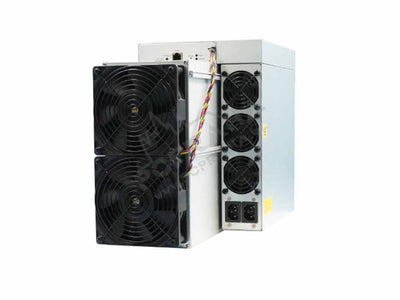
| Antminer X5 (ASIC, legacy model) | 212 kH/s | 1,350 W | 167.0 | 145.8 | +21.2 | 5.2 Kč/kWh |
The table shows the key rule: with Monero, performance per watt matters, not clock speed. The energy-efficient 65 W Ryzen 9 7900 does better than the more powerful Ryzen 9 9950X. Server processors are in profit, but they cost tens of thousands of crowns themselves, and buying them just for mining makes no sense. You can find a calculation for 78 processors with your own electricity price on the CPU profitability page. A detailed analysis (when the PC is running anyway, heating, solar panels) is in the article CPU mining in 2026.
What hardware to mine Monero with
The processor (CPU) is the main hardware for Monero, and processors with a large L3 cache perform best. Graphics cards are considerably less efficient on RandomX and do not pay off.
Only one ASIC miner exists for RandomX: the Antminer X5 from 2023. It is no longer bought new today and is worse per watt than a server EPYC. Bitmain cancelled its successor, the Antminer X9, before it shipped; see Antminer X9 cancelled. The planned RandomX v2 upgrade may also further change the performance of the old ASICs.
In our service centre we mostly see PCs that have mined 24/7 for years. They typically have clogged coolers, dried-out thermal paste and worn fans and power supplies. If you mine on your own computer, keep an eye on the processor temperature (ideally below 80 °C on a desktop) and clean out the dust every few months.
How to start: pool, wallet and XMRig
- Create a wallet: the official Monero GUI from getmonero.org, or Feather Wallet or Cake Wallet. The address starts with the digit 4 or 8. Write the seed (25 words) down on paper.
- Download XMRig only from xmrig.com or from the project's GitHub. Antivirus software often flags it because scammers abuse it for covert mining on other people's computers.
- Choose a pool. The community recommends P2Pool: it is decentralised, has no fee and payouts go straight to your wallet. Traditional pools (for example SupportXMR) are easier to set up. How pools pay out is explained in the article PPS, PPLNS and FPPS.
- Enable huge pages (large memory pages), which speed up RandomX by tens of percent.
- Measure the PC's consumption with a power meter and work out your profit using the table above. If it comes out negative, stop mining.
Alongside Monero you can also mine Tari on the same hashrate (merge mining); see Tari (XTM).
Risks: regulation, network upgrade and hashrate concentration
EU regulation
The EU Anti-Money Laundering Regulation (AMLR) bans crypto-asset service providers (exchanges, exchange offices) from handling anonymity-enhancing coins from July 2027. Major exchanges delisted Monero earlier, for example Binance in February 2024 and Kraken for the EEA in 2024. For miners this creates a practical problem: it will become ever harder to legally exchange mined XMR for fiat currency in the EU. We describe the tax rules for mined coins in the article Mining in the Czech Republic: taxes and laws.
FCMP++ and RandomX v2
The developers are preparing the biggest upgrade in Monero's history. FCMP++ will replace ring signatures (instead of 16 possible inputs, the entire blockchain will form the "ring"), and RandomX v2 will arrive in the same hard fork. It has been running on a test network (stressnet) since 5 October 2026. As of 10 November 2026 no mainnet launch date has been set. Processor performance may change after the switch, so treat the figures in the table as the current state.
Hashrate concentration
In August 2025 the Qubic project redirected a large amount of hashrate to Monero and claimed to control over 50% of it. Several of the most recent blocks were reorganised (rewritten). For small miners this means less stable payouts, which is why the community recommends the decentralised P2Pool.
Price
The yield in crowns depends on the XMR price and the network hashrate and changes every hour. This is not investment advice and the yield is not guaranteed.
Monero or Zcash?
Both coins are privacy coins, but they differ in both mining and privacy. Zcash is mined on ASIC miners (Equihash) and shielded transactions are optional. With Monero privacy is mandatory and it is mined on processors. If you want to mine a privacy coin on a larger scale, Zcash on ASICs currently works out better; see Zcash (ZEC). Monero is more of a choice for a PC that is running anyway.
What next
- CPU profitability: live yield of 78 CPUs with your electricity price.
- CPU mining in 2026: when it pays off and how to set it up.
- ASIC miner profitability: what earns more than a processor.
Sources
- getmonero.org: official Monero website
- RandomX: algorithm specification (GitHub)
- Monero: "fcmp++ hf" milestone (GitHub)
- Monero: RandomX v2 in hard fork v17 (GitHub)
- CryptoTicker: FCMP++ stressnet fork, 5 October 2026
- The Block: Qubic and the Monero block reorganisation (08/2025)
- Cointelegraph: EU to ban privacy coins at service providers from 2027
- WhatToMine: CPU coin profitability
Frequently asked questions
Can Monero be mined on an ordinary computer?
Is there an ASIC miner for Monero?
Does Monero have a halving?
Is Monero legal in the Czech Republic?
Which pool should I choose for Monero?
This text was prepared with the help of AI. Facts, figures and procedures were checked by Yegor.