Why Bitcoin and Kaspa transactions cannot be forged – explained simply
A Bitcoin or Kaspa transaction cannot be forged, because every payment must be signed with the owner's private key and every node in the network checks that signature itself. Without the key, nobody can spend someone else's coins or change the amount or recipient. Rewriting already confirmed history would require more computing power than the entire honest network – and that costs more than an attacker could gain. The real risk is therefore not a "hacked blockchain", but a stolen key and a scammer who persuades you to send the money yourself.
Summary
- Coins do not "sit in an account". They belong to whoever holds the private key and can use it to create a valid digital signature.
- The signature is mathematically bound to the content of the transaction. Changing a single character (amount, address) invalidates the signature.
- Every node in the network checks every transaction itself. It rejects an invalid one, even if it was sent by the largest miner.
- Proof of work prevents the same coins from being spent twice: as of 29 October 2026, rewriting Bitcoin's history would require over 1,000 EH/s, roughly 4 million of the latest miners.
- The real threats lie elsewhere: phishing, fake wallets, leaked seed phrases and scams such as "flash USDT". Your own caution is the main protection against them.
What "forging a transaction" would actually mean
When people talk about forging cryptocurrency, they usually mean one of four things. The network handles each of them with a different mechanism:
| Fraud attempt | What the attacker wants | What prevents it |
|---|---|---|
| Spend someone else's coins | send himself coins from an address he does not own | digital signature (impossible without the private key) |
| Alter a signed transaction | change the amount or recipient of someone else's payment | the signature is valid only for the exact content of the transaction |
| Create coins out of thin air | credit himself coins that never existed | every node checks that the transaction's inputs exist and are unspent |
| Spend twice (double spend) | pay, receive the goods and then "reverse" the payment | proof of work and waiting for confirmations |
Bitcoin's creator already pointed out in the original 2008 document (the white paper) that even an attacker with enormous computing power cannot create value out of thin air or take money that never belonged to him. The only thing he can try is to take back a recent payment of his own. Let us go through it step by step.
How keys and digital signatures work
It all starts with a pair of keys. The private key (a secret number known only to you) is essentially a random 256-bit number. There are roughly 1077 possible keys – on the order of the number of atoms in the visible universe. Guessing someone else's key is therefore practically impossible.
A one-way calculation derives the public key from the private key, and from that the address to which others send you coins. Going forward is easy; going back (from the address to the private key) is computationally infeasible today. Bitcoin and Kaspa both use the same elliptic curve, secp256k1.
When you want to pay, your wallet takes the content of the transaction (from where, to where, how much) and uses your private key to create a digital signature for it. Anyone can then use your public key to verify two things:
- that the signature was created by the owner of the private key,
- that the content of the transaction has not changed by a single character since it was signed.
Bitcoin originally used ECDSA signatures. Since the Taproot upgrade (November 2021, block 709,632), it also supports Schnorr signatures under the BIP-340 standard. Kaspa uses Schnorr signatures by default and also supports ECDSA. In terms of security, the same applies to both: whoever does not have the key cannot produce a valid signature.
Why a signed transaction cannot be changed
The signature is not created for the "message" as a whole, but for its hash (a fingerprint of the data). A hash function turns data of any length into a short fingerprint of fixed length. Change a single letter and the fingerprint comes out completely different.
If someone changed the amount in a transaction on its way from 0.01 BTC to 1 BTC, or slipped in their own address, the fingerprint would change and the original signature would no longer match it. Nodes discard such a transaction immediately. The attacker cannot create a new signature, because he does not have your key.
Hashes also hold entire blocks together. Each block contains the fingerprint of the previous block, so they form a chain – hence the name blockchain. Changing a transaction in an old block would change its fingerprint and "break" every block after it.
Who checks transactions: nodes and UTXO
The network has no central server that decides what is valid. Transactions are checked by thousands of nodes (computers with a full copy of the network's rules and history). Each of them verifies every transaction and every block itself, independently of the others.
Bitcoin and Kaspa record money as UTXO (unspent outputs of previous transactions). It works much like banknotes in a wallet: each transaction "uses up" specific earlier outputs and creates new ones. For every payment, a node checks:
- that the outputs used really exist,
- that they have not yet been spent,
- that they carry a valid signature,
- that the sum of the outputs does not exceed the sum of the inputs.
If anything does not add up, the node does not accept the transaction or pass it on. The same applies to blocks: nodes reject a block containing an invalid transaction, even if it was mined by the largest pool in the world. Miners therefore cannot bypass the rules – they can only decide the order of valid transactions.
Double spend and proof of work: why history cannot be rewritten
One last option remains: pay, wait for the goods and then push through a different version of history in which the payment does not exist. This is called a double spend. It is prevented by proof of work: the network accepts the version of history backed by the most work performed.
Each new block is one confirmation of a transaction. On Bitcoin, a block is added roughly every 10 minutes, and for larger amounts merchants traditionally wait for 6 confirmations, i.e. about an hour. To "erase" a payment, an attacker would have to secretly mine a longer alternative chain faster than the rest of the network. That is only possible with more hashrate than the entire honest network – hence the term 51% attack.
What an attack on Bitcoin would cost: our calculation
As of 29 October 2026, the Bitcoin network's hashrate is around 1,080 EH/s (mempool.space). Converted to the most efficient air-cooled miner in our range:
| Item | Bitcoin (BTC) |
|---|---|
| Network hashrate (29 October 2026) | ~1,080 EH/s = 1.08 billion TH/s |
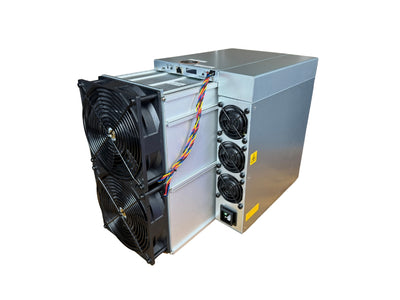
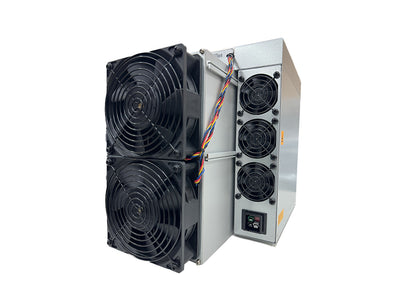
| Miner used for the calculation | Antminer S21 XP, 270 TH/s, 13.5 J/TH |
| Number of machines just to match the network | ~4 million units |
| Cost of the machines (85,499 Kč per unit from us as of 29 October 2026) | ~340 billion Kč |
| Power draw | ~14.6 GW (roughly twice the average consumption of the entire Czech Republic) |
| Electricity for 1 hour at 2 Kč/kWh | ~29 million Kč |
No manufacturer has that many spare machines, and they cannot be produced within weeks. There is also an economic safeguard that Satoshi Nakamoto himself described: anyone with that much hashrate would earn more by mining honestly. Every hour, 6 blocks of 3.125 BTC are created, i.e. 18.75 BTC – at a price of 1 753 594 Kč per BTC, that is tens of millions of crowns. An attack would also crash the price of the very coin the attacker is mining.
How it works on Kaspa: blockDAG and 10 blocks per second
Kaspa is built on the same foundations (keys, signatures, UTXO, proof of work), but it arranges blocks differently. Instead of a single chain, it creates a blockDAG (a graph of blocks): blocks can be created in parallel, and each refers to several predecessors. The GHOSTDAG protocol then arranges them into a single order on which all nodes agree.
Since the Crescendo hard fork (May 2025), Kaspa produces 10 blocks per second. A transaction is therefore confirmed within seconds, whereas Bitcoin takes about an hour for secure settlement. The next step, the DAGKnight consensus, is still only planned as of 29 October 2026. You can find more about the network in our article Kaspa (KAS).
| Parameter | Bitcoin | Kaspa |
|---|---|---|
| Structure | chain of blocks | blockDAG (GHOSTDAG) |
| Block rate | 1 block every ~10 minutes | 10 blocks per second |
| Signature | ECDSA, since 2021 also Schnorr (BIP-340) | Schnorr (default), also ECDSA |
| Curve | secp256k1 | secp256k1 |
| Coin accounting | UTXO | UTXO |
| Consensus | proof of work (SHA-256) | proof of work (kHeavyHash) |
| Secure confirmation | usually 6 blocks ≈ 1 hour | a matter of seconds |
| Network hashrate (29 October 2026) | ~1,080 EH/s | ~351 PH/s |
What an attack on Kaspa would cost
To be honest, a smaller network is cheaper to attack than Bitcoin. According to our data, Kaspa's hashrate is roughly 351 PH/s as of 29 October 2026. Matching it would take around 8,800 Antminer KS7 machines (40 TH/s, 3,080 W) for approximately 630 million Kč. The power draw would be about 27 MW, and electricity would cost around 54,000 Kč per hour.
That is orders of magnitude less than for Bitcoin, but it is still thousands of machines that are not freely available on the market. An attack would also damage the price of KAS and therefore the value of the machines the attacker invested in. A practical rule: for large amounts on smaller networks, it is sensible to wait longer than the first confirmation. This applies to every proof-of-work coin – the lower the network's hashrate, the more caution is needed.
What the real risks are and how to protect yourself
Maths cannot be bypassed, but people can. Almost all the cryptocurrency losses you hear about were not caused by "cracking the blockchain", but by a key or money ending up with a scammer.
- Theft of a key or seed phrase. A seed phrase (12–24 words for restoring a wallet) is the same as a private key. Whoever knows it owns your coins. Never photograph it, store it in the cloud or enter it on any website.
- Phishing and fake wallets. Fraudulent apps and websites look like the original and "request" your seed phrase. We explain how to spot them in our article Fake software wallets.
- "Flash BTC / flash USDT". A scammer promises software that sends "temporary" coins, or sends you a worthless token that merely looks like USDT. Nobody can send real bitcoin without the key. Always verify a payment in a blockchain explorer – for tokens, also by the contract address.
- Unconfirmed transactions. A transaction waiting in the mempool (the queue of unconfirmed transactions) has not yet been paid. When selling goods for Bitcoin, wait for confirmation.
- Quantum computers. A sufficiently large quantum computer could theoretically calculate a private key from a public key. Mainly addresses whose public key is already visible on the network would be at risk (old address types, reused addresses). No such computer exists today, and estimates of when one might appear vary by decades. Bitcoin developers are already preparing the BIP-360 proposal for resistant addresses. Practical advice that applies today: do not reuse the same address.
For larger amounts, the safest option is a hardware wallet that never lets the key into your computer. We show recommended wallets for Kaspa in our guide Kaspa wallet: how to set one up.
This article explains technical principles and does not constitute investment advice.
What next
- How blocks are created and what miners do is explained in our article What is cryptocurrency mining and how does it work.
- How much securing the network with a specific machine earns today is shown in our ASIC miner profitability table.
Sources
- Satoshi Nakamoto: Bitcoin – A Peer-to-Peer Electronic Cash System (2008)
- Bitcoin Developer Guide: Transactions
- BIP-340: Schnorr Signatures for secp256k1
- Sompolinsky, Wyborski, Zohar: PHANTOM GHOSTDAG – A Scalable Generalization of Nakamoto Consensus
- Kaspa.org: history and technology of the network
- Kaspa KIP-17 (verification of Schnorr and ECDSA signatures)
- mempool.space: Bitcoin network hashrate and difficulty
- Cointelegraph: what the BIP-360 proposal changes
Frequently asked questions
Může hacker poslat bitcoiny z mé adresy bez mého klíče?
Mohou těžaři změnit moji transakci nebo si připsat mince?
Co je 51% útok a hrozí Bitcoinu?
Je Kaspa stejně bezpečná jako Bitcoin?
Co je flash BTC nebo flash USDT?
This text was prepared with the help of AI. Facts, figures and procedures were checked by Yegor.