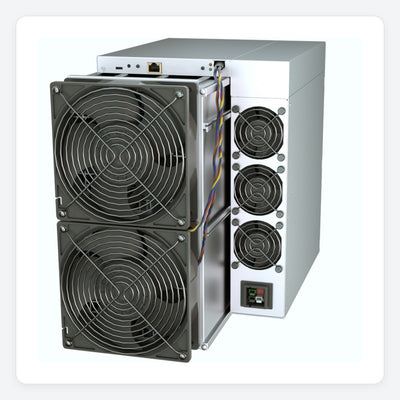
Mining difficulty: what it is and how it is recalculated

Mining difficulty is a number that tells you how hard it is to find a new block. The network recalculates it by itself according to how much hashrate is taking part in mining: when hashrate rises, difficulty goes up; when it falls, difficulty goes down. This is why a new Bitcoin block is found on average every 10 minutes – whether a thousand machines are mining or a million.
Summary
- Bitcoin recalculates difficulty once every 2,016 blocks, i.e. roughly every two weeks.
- Higher difficulty = fewer coins for the same hashrate. The earnings of 1 TH/s fall in roughly the same proportion as difficulty rises.
- On Bitcoin, a single adjustment is limited to at most four times up or a quarter down.
- Other networks (Kaspa, Bitcoin Cash, Dogecoin) recalculate difficulty continuously after every block.
How Bitcoin difficulty is recalculated
A miner looks for a block hash that is lower than the target value. Difficulty expresses how many times harder today's target is than it was for the very first block. At the beginning of November 2026 it stood at around 148.4 trillion (148.4 T).
After every 2,016 blocks, the network compares how long it actually took to mine them with the planned 14 days (2,016 × 10 minutes):
- Blocks came faster than every 10 minutes → hashrate has grown → difficulty goes up.
- Blocks came more slowly → hashrate has dropped → difficulty goes down.
- The change is proportional to the deviation: if the period took 7% longer, difficulty falls by roughly 7%.
A real-world example: in the period from 29 Oct 2026, blocks were found on average roughly every 10.7 minutes. That is why the adjustment at block 975,744, expected on 13 Nov 2026, was estimated to cut difficulty by approximately 6–8%. It would be the biggest reduction since June (−10.1% at the time). You can find current values in our mining statistics.
Why difficulty matters to miners
The block reward is fixed (3.125 BTC on Bitcoin since the halving in 2024), but it is shared among all miners. If difficulty rises by 5%, the same miner at the same BTC price mines about 5% less. If it falls, it mines more.
Today, 1 TH/s on Bitcoin earns approximately 0,64 Kč per day (recalculated every hour, last updated 13. 11. 2026). For illustration, our own calculation as of 13 Nov 2026:
| Scenario (BTC price unchanged) | Earnings of 1 TH/s per day | Antminer S21+ Hyd 358 TH/s per day |
| Difficulty 148.4 T (as of 13 Nov 2026) | 0.642 Kč | 230 Kč |
| Difficulty −7% | 0.690 Kč | 247 Kč |
| Difficulty +5% | 0.611 Kč | 219 Kč |
From running our hosting we know that lower difficulty often follows a wave of shutdowns – older machines get switched off once mining stops paying off. That helps the remaining miners in the short term. The decisive factor, however, remains the price of electricity: on our hosting it starts from 1,15 Kč per kWh. We explain how to calculate electricity costs in the entry ASIC miner power consumption and J/TH.
How other networks do it
| Network | Target block time | When difficulty changes |
| Bitcoin | 10 minutes | every 2,016 blocks (~2 weeks) |
| Litecoin | 2.5 minutes | every 2,016 blocks (~3.5 days) |
| Bitcoin Cash | 10 minutes | after every block (ASERT algorithm, since 11/2020) |
| Kaspa | 0.1 s (10 blocks per second) | continuously after every block |
Continuous recalculation protects smaller networks from block production stalling for days when a large miner leaves.
Related terms
- Hashrate – the total computing power of the network (around 1,000 EH/s for Bitcoin in November 2026).
- Hashprice – how much a unit of hashrate earns per day (e.g. Kč per 1 TH/s).
- Halving – cutting the block reward in half.
- Proof of Work – the principle that difficulty is built on.
What next
- Current ASIC miner profitability – how much a specific machine earns today.
- Bitcoin difficulty rose by 5.92% – what the last big increase meant.
- ASIC miner hosting – mining with cheaper electricity.
Sources
Frequently asked questions
What is mining difficulty?
How often does Bitcoin difficulty change?
What does higher difficulty mean for my miner?
Why does difficulty fall?
Does difficulty change for other cryptocurrencies too?
This text was prepared with the help of AI. Facts, figures and procedures were checked by Yegor.