GPU mining rig in 2026: what it is, how much it earns and when it pays off
A mining rig is a computer that runs 4–8 graphics cards at once instead of one and mines cryptocurrencies with them around the clock. As of 29 October 2026, a rig with 6× RTX 5070 Ti earns roughly 530 Kč a day before electricity, and about 370 Kč net at home at 4.5 Kč/kWh. However, almost all of that income depends on a single young coin, Pearl (PRL) – and that is the biggest risk you need to reckon with.
Summary
- Mining rig (GPU rig) = an open frame, a motherboard, a low-end processor, risers, powerful power supplies and 4–8 graphics cards. It runs on Hive OS.
- In 2026 only NVIDIA RTX 50 cards make sense. Current AMD cards earn almost nothing from mining once electricity is deducted.
- Today's income depends largely on the Pearl coin. Without it, a rig mining classic GPU coins at home would not even cover its electricity.
- Today a rig earns more than a Bitcoin ASIC for similar money, but carries a much greater risk of rule changes and of the price of a single coin.
- At home a rig needs a dedicated 16 A circuit, ventilation and a place where noise and heat are not a problem. The alternative is our hosting.
What a mining rig is and how it differs from a gaming PC
A mining rig is essentially a computer built for a single task: to keep the graphics cards computing for as long and as efficiently as possible. It needs no case, monitor or powerful processor. Everything not related to the cards is kept as simple and cheap as possible.
A gaming computer has one card and gets switched off. A rig has its cards side by side in an open frame, runs 24 hours a day and is controlled remotely through a browser. The cards are undervolted, so they draw less power than the manufacturer states for gaming.
Why only smaller coins are mined on graphics cards today, and what can no longer be mined on them, is explained in the GPU mining entry in our Mining wiki.
What a mining rig consists of
This is the platform on which we build our mining rigs (components as of 29 October 2026):
| Part | What we use | What it does |
| Frame | open mining frame for up to 8 cards | holds the cards spaced apart so they do not heat each other |
| Motherboard | GIGABYTE B760 DS3H DDR4 | connects the cards, processor and drive |
| Processor | Intel Core i3-14100F | only runs the system, not used for mining |
| Memory and drive | 16 GB DDR4, 500 GB NVMe SSD | Hive OS runs from the drive |
| Risers | PCIe x1 → x16, one per card; with 6 cards also an M.2 adapter | connect the card to the board by cable so it can stand in the frame |
| Power supplies | 1000 W 80+ Gold ATX 3.1 (6× RTX 5060), 1300 W or two PSUs for more powerful builds | power the cards; ATX 3.1 because of the 12V-2x6 connector on RTX 50 |
| Cooling and other | 3× 120 mm fan, USB watchdog, cabling | airflow and automatic restart if the rig freezes |
Risers transfer data only over a slow PCIe x1 link. That is enough for mining, because the card sends very little data. For artificial intelligence, where a lot of data flows between the card and the board, it is a bottleneck. A rig is therefore not a cheap substitute for an AI server.
Hive OS is a Linux system for mining rigs. You set the pool, wallet and card profile (voltage, clock, fan speed) in it and monitor the rig from your phone. It is free for a small number of rigs; above the limit you pay a monthly fee per rig according to the Hiveon price list.
Which graphics cards for a rig in 2026
A card's earnings are determined mainly by efficiency: how much it mines per watt. Comparison of new NVIDIA RTX 50 cards on the Pearl coin as of 29 October 2026 (earnings according to WhatToMine, card power draw with mining settings, electricity 4.5 Kč/kWh):
| Card | Revenue Kč/day | Card power draw | Electricity Kč/day | Profit Kč/day | Profit per 1,000 Kč of card price |
| RTX 5060 | 35 | 100 W | 11 | 24 | 2.1 Kč |
| RTX 5070 | 59 | 160 W | 17 | 42 | 1.9 Kč |
| RTX 5070 Ti | 88 | 220 W | 24 | 64 | 2.1 Kč |
| RTX 5080 | 104 | 250 W | 27 | 77 | 1.7 Kč |
| RTX 5090 | 198 | 520 W | 56 | 142 | 2.0 Kč |
Card prices are our purchase prices as of 29 October 2026 (RTX 5090 market price around 70,000 Kč). The best choice today is the RTX 5070 Ti: a good ratio of profit to both price and power draw. The RTX 5060 is the cheapest entry point; the RTX 5090 is powerful but expensive and harder to get.
AMD cards (RX 9070, RX 9060 XT) earn significantly less on the same coins today and are close to zero after electricity. That is why we do not build rigs with them. Specifications of older and newer cards can be found in our list of graphics cards.
How much a mining rig earns today
Calculation for our ready-made builds as of 29 October 2026. At home we assume 4.5 Kč/kWh, on hosting 1.42 Kč/kWh (Finland location). The lowest price on our hosting today is 1,15 Kč/kWh.
| Rig | Price (at home) | Power draw | Revenue Kč/day | Profit at home Kč/day | Profit on hosting Kč/day | Payback at home / hosting |
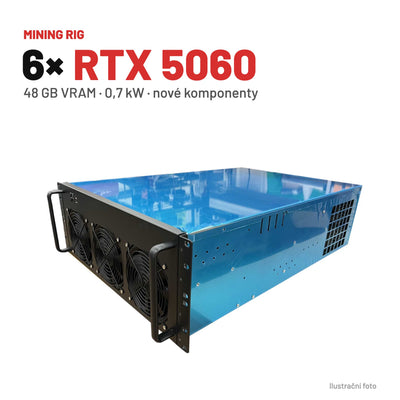
| 6× RTX 5060 | 107,399 Kč | 0.7 kW | 212 | 134 | 187 | ≈ 800 / 470 days |
| 6× RTX 5070 | 179,799 Kč | 1.1 kW | 353 | 233 | 315 | ≈ 770 / 470 days |
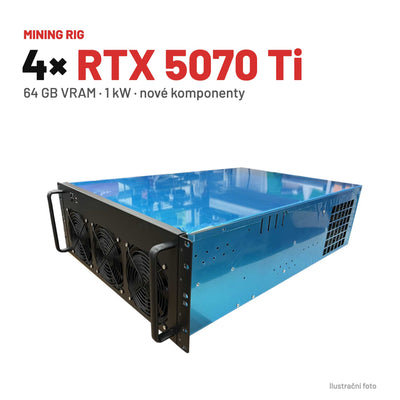
| 4× RTX 5070 Ti | 169,899 Kč | 1.0 kW | 353 | 242 | 318 | ≈ 700 / 440 days |
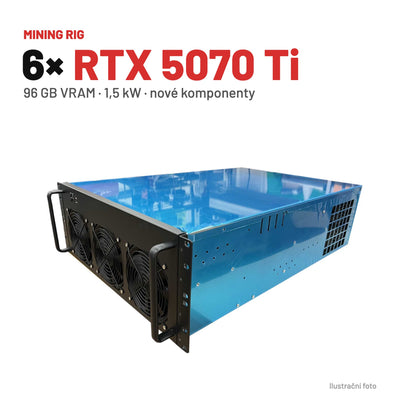
| 6× RTX 5070 Ti | 245,099 Kč | 1.5 kW | 529 | 367 | 478 | ≈ 670 / 420 days |
| 4× RTX 5080 | 238,899 Kč | 1.2 kW | 417 | 293 | 378 | ≈ 820 / 520 days |
| 4× RTX 5090 | 355,599 Kč | 2.3 kW | 791 | 540 | 712 | ≈ 660 / 410 days |
Payback on hosting is calculated from the price of the Hosted variant. The calculation does not include the pool fee (usually 1–2 %) or any Hive OS fee. Above all, it assumes today's coin price and today's network difficulty. Difficulty usually rises over the year and the price of small coins fluctuates by tens of per cent, so the actual payback tends to be longer – or the rig may never pay for itself at all.
We recalculate the current earnings of individual cards every hour on the GPU mining profitability page (last update: 29. 10. 2026). We do not guarantee earnings or payback.
Why Pearl as the main coin is a risk
Pearl (PRL) launched its mainnet on 27 April 2026. Instead of classic hashing, it has cards compute matrix multiplications – the same operation that artificial intelligence uses (so-called proof of useful work). It is mined on NVIDIA cards via CUDA. For RTX 50 cards it is currently the most profitable coin of all.
There is a catch, though. It is a coin just half a year old with low liquidity on smaller exchanges. During 2026 its price ranged from roughly 0.14 USD (July) to more than 1.6 USD, and as of 29 October 2026 it is around 38.7 Kč. In August 2026 the network changed its mining rules, significantly reducing the effective hashrate of some miners. According to the authors of the mining software, a further upgrade could put ordinary gaming cards at an even greater disadvantage.
What this means in numbers: the second most profitable coin, Quantus, currently earns about 65–70 % of what Pearl does. Classic GPU coins are far lower – an RTX 5070 Ti mines around 4 Kč a day on Ravencoin, while Pearl gives 88 Kč. If both Pearl and Quantus stopped paying off, a rig at home would not even earn its electricity.
The advantage of a rig is that it can be switched to another coin in Hive OS with a few clicks. And even after years of mining, the cards still have resale value for gamers or for AI computing. An ASIC tied to one specific network does not.
Mining rig or ASIC miner?
An ASIC miner can mine only one algorithm, but it is many times more efficient at it. Comparison of a rig and a Bitcoin ASIC from our range as of 29 October 2026:
| Parameter | Mining rig 6× RTX 5070 Ti | Antminer S21 XP 270 TH/s |
| Price (at home) | 245,099 Kč | 85,499 Kč |
| Power draw | 1.5 kW | 3.6 kW |
| Revenue Kč/day | 529 (Pearl) | 212 (Bitcoin) |
| Profit at home at 4.5 Kč/kWh | +367 Kč/day | −181 Kč/day |
| Profit on hosting at 1.42 Kč/kWh | +478 Kč/day | +88 Kč/day |
| What the income depends on | one young coin with low liquidity | Bitcoin, the most liquid cryptocurrency |
| Switching to another coin | yes, dozens of algorithms | only SHA-256 coins |
| Hardware value after mining | cards can be sold to gamers or for AI | only as a miner |
| Noise | like several gaming PCs under full load | around 75 dB, at home only with soundproofing |
On Bitcoin, 1 TH/s currently earns 0,79 Kč a day. So a rig comes out better today, but at the cost of significantly higher risk. An ASIC is the more predictable choice for cheap electricity on hosting. A rig is more of a bet that GPU coins will stay profitable. We compare ASICs across coins on the ASIC miner profitability page.
Rig at home or on our hosting?
Running at home
- Electricity: a 16 A socket circuit can theoretically handle 3.68 kW. For continuous operation we recommend no more than 2.3 kW per circuit. A 4× RTX 5090 rig therefore belongs on a dedicated circuit, ideally checked by an electrician.
- Heat: a rig drawing 1.5 kW gives off the same heat as a 1.5 kW electric heater. In winter it will heat the room, in summer it will overheat it. The cards prefer an ambient temperature of up to 30 °C.
- Noise: a rig is quieter than an air-cooled ASIC, but six cards under full load do not belong in the living room. A utility room, cellar or garage with ventilation is suitable.
- Dust: the open frame draws in dust; the cards need blowing out roughly once a quarter.
Running on hosting
On our hosting you pay significantly less for electricity than at home, and we take care of cooling, connectivity and monitoring. That is why the profit in the table above is 50–170 Kč a day higher and the Hosted variant is cheaper. We agree on the location for the rig when you order. We write more about choosing between home mining and hosting in the article Does home crypto mining pay off in the Czech Republic?
How to get started with a mining rig step by step
- Check the current earnings of the cards on the GPU mining profitability page and plug in your electricity price.
- Decide whether the rig will run at home or on hosting. At home, check the circuit breaker, circuit and ventilation.
- Choose the size: 6× RTX 5060 for a cheap entry, 6× RTX 5070 Ti as the best ratio of profit to price, 4× RTX 5090 only on a dedicated circuit or on hosting.
- Prepare a wallet for the coin you will mine. For lesser-known coins, check that both the wallet and the exchange work.
- We build the rig from new parts and test it within 7 days. We install Hive OS and help you with card profiles and the pool.
- Keep an eye on earnings. When profitability changes, switch the rig to another coin in Hive OS.
Who a mining rig is for
It suits you if you have cheap electricity or surplus power from solar panels, understand the risk of small coins and appreciate that the cards keep their resale value after mining. It also makes sense for anyone who wants a rig on hosting as a complement to ASICs.
It does not suit you if you expect a certain and stable income, have nowhere to put the rig because of noise and heat, or need a machine for AI. For AI, a computer with full-bandwidth card connections is better. For predictable Bitcoin mining, an ASIC on hosting is better.
What next
- Ready-made builds with prices for home and hosting can be found in the Mining rigs collection – for example the Mining rig 6× RTX 5070 Ti.
- Current earnings of specific cards: GPU mining profitability.
- How much electricity costs in our data centres: Miner hosting.
Sources
Frequently asked questions
Kolik vydělá mining rig v roce 2026?
Jaké grafické karty jsou nejlepší do těžebního rigu?
Co těží mining rig s kartami RTX 50?
Vyplatí se víc mining rig, nebo ASIC miner?
Můžu mining rig provozovat doma?
Hodí se těžební rig i na umělou inteligenci?
This text was prepared with the help of AI. Facts, figures and procedures were checked by Yegor.