Black Friday in crypto: is this the bottom? How big investors buy
In short: in November 2026 bitcoin lost up to a quarter of its value and on the morning of Saturday 21 November touched 55,300 USD, its lowest level since September 2024. The Fear & Greed Index fell to 6 out of 100. Nobody knows whether this is the bottom. That is why big investors do not try to guess the right day: they buy in stages and keep a reserve.
This article describes how people usually approach a market like this. It is not investment advice. We sell ASIC miners, including the machines mentioned in this article.
What happened in the market
- Price: at the end of September bitcoin was close to 90,000 USD, around 66,000 USD on 14 November and around 60,100 USD on the evening of 21 November. Compared with the all-time high of 126,198 USD (6 October 2025), that is a fall of more than half.
- Fear: according to CoinMarketCap, the Fear & Greed Index fell to 6 out of 100 on 21 November, just one point above this year's low of 6 February 2026.
- ETFs: US spot bitcoin funds lost about 3.6 billion USD in November. BlackRock IBIT recorded its largest daily outflow since launch on 19 November (541 million USD).
- Leverage: in the 24 hours to Saturday 21 November the market liquidated more than 2 billion USD of leveraged positions.
- Causes: a sell-off in AI stocks (Nasdaq −10% in a week), higher inflation in the US and expectations that the Fed will raise rates in December.
- Miners: bitcoin difficulty fell by 9.1% on 14 November. Less efficient machines left the network.
Is this the bottom? What the data says
| For a bottom | Against |
|---|---|
| Extreme fear (6/100) – similar readings marked the bottoms of 2018, 2020 and 2022. | The index alone does not confirm a bottom. In February 2026 it was at 5 and the price kept swinging for a long time afterwards. |
| The price has fallen below the lowest band of the rainbow chart. It has only been this low at the bottoms of 2020 and 2022. | The rainbow chart predicts nothing, and the price can stay below the rainbow for months. |
| 13.5 months have passed since the peak. Previous bottoms came 12–13 months after the peak. | Analysts at Wintermute warn that without money returning to ETFs, bitcoin could fall into the 50,000 USD range. |
| Miner capitulation: difficulty −9.1%, weak machines are being switched off. | The Fed may raise rates in December and risk assets would keep suffering. |
The data can be read both ways. That is why experienced investors do not ask whether today is the bottom, but how to buy so that it does not hurt if they are wrong.
How big investors buy
1. In stages, not all at once
They split their budget into several parts, most often four, and buy gradually. This is called DCA (dollar-cost averaging). They set the rule in advance so that emotions do not make the decisions:
- by time – for example one quarter every week or every month,
- by price – another quarter after every 10% drop.
2. They keep a reserve (stablecoins)
Money that has not yet been invested is not left sitting without a plan. Some investors hold it in stablecoins, i.e. tokens pegged to the dollar or the euro (USDC, EURC). The reserve is available immediately if the market falls even further.
3. Risky bets only with a small portion
Speculative tokens make up only a small fraction of the portfolio. If they fail, the whole is not at risk.
Example budget split: 80 / 18 / 2
This is what a cautious model can look like. The figures are illustrative, not a recommendation for any particular person:
| Part | Share | Purpose | Main risk |
|---|---|---|---|
| Stablecoins (USDC, EURC) | 80% | A cash pool from which bitcoin (or ether) is bought in 4 steps | Dependence on the issuer and regulation. A stablecoin is not a bank deposit and is not covered by deposit insurance. |
| Layer 2 network tokens (e.g. Arbitrum, Optimism) | 18% | A bet on the growth of networks built on top of Ethereum | High volatility. Many L2 tokens are 80–95% below their highs and may never recover. |
| Memecoins | 2% | A “lottery ticket” | Expect that you may lose the whole amount. |
The exact percentage matters less than the principle: most of the money sits safely and is invested gradually, and only a small part is put at risk.
What it means in numbers: 100,000 Kč in 4 parts
A model situation at an exchange rate of 22.30 Kč/USD. One investor buys everything at once at 60,000 USD. The other buys four times 25,000 Kč while the price moves down and back up again:
| Purchase | BTC price | Bought |
|---|---|---|
| 1st quarter | 60,000 USD | 0.01868 BTC |
| 2nd quarter | 54,000 USD | 0.02076 BTC |
| 3rd quarter | 50,000 USD | 0.02242 BTC |
| 4th quarter | 58,000 USD | 0.01933 BTC |
| Total in stages | average 55,228 USD | 0.0812 BTC |
| All at once | 60,000 USD | 0.0747 BTC |
Here, buying in stages brought 8.6% more bitcoin. But it only works if the price keeps swinging after the first purchase. If it had only risen from 60,000 USD, buying all at once would have been better. So spreading purchases does not increase profit; it reduces the risk of buying everything at the worst moment.
What about mining? An ASIC as buying in stages
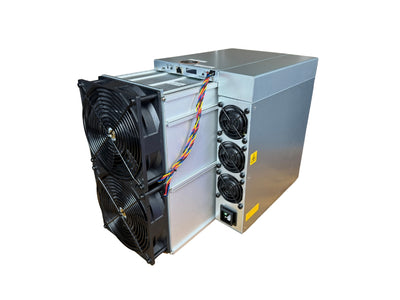
A miner does DCA automatically: the machine “buys” bitcoin every day at the price of electricity. In a downturn the machines themselves also get cheaper, and after a difficulty drop each TH/s mines a little more. That is why some miners buy machines precisely in times of fear. More in the article Bitcoin Rainbow Chart: what history tells us about ASICs.
At home, at a normal electricity price, bitcoin machines generally do not make money today. They make sense with cheap electricity, for example in hosting. Whether a machine pays for itself depends on the bitcoin price, difficulty and the price of electricity. Current figures for every machine are shown on the ASIC miner profitability page, and you will find efficient models in the Bitcoin ASIC miners category.
What to watch out for
- No leverage. The November crash wiped out positions worth more than 2 billion USD in a single day. Anyone buying on credit or with leverage can lose everything, even if the market later recovers.
- Only money you can afford to lose. A bottom can last for months and the price can fall further.
- Safe storage. Do not leave larger amounts on an exchange. Use your own (hardware) wallet.
- Taxes. In the Czech Republic, since 2025, the sale of cryptocurrencies is tax-exempt after 3 years of holding or up to income of 100,000 Kč a year. Check the details with a tax adviser.
What next
- Hashprice: how much 1 TH/s earns today
- Mining difficulty: what it is and how it is recalculated
- When to buy an ASIC miner
Sources
- CEO Economy: the crypto week to 21 November 2026 (price, ETFs, liquidations, difficulty)
- KuCoin News: bitcoin below 56,000 USD, Fear & Greed Index at 6
- Forbes: the crypto market has lost 2 trillion USD since the end of September
This is not investment advice. Cryptocurrency prices and mining returns change, and past performance does not guarantee future results. Data as of 22 November 2026.
Frequently asked questions
Is November 2026 the bottom for bitcoin?
What is DCA, or buying in stages?
Why do investors keep a reserve in stablecoins?
Is it worth buying an ASIC miner during a downturn?
Is there tax on selling cryptocurrencies in the Czech Republic?
This text was prepared with the help of AI. Facts, figures and procedures were checked by Yegor.