How much electricity Bitcoin mining uses worldwide
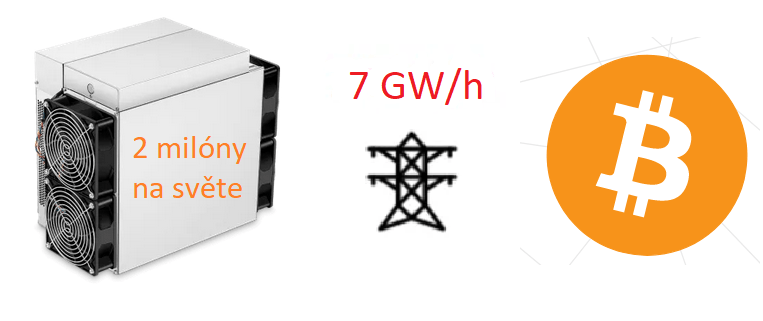
The entire Bitcoin network currently draws roughly 15–24 GW of electrical power, most likely around 20 GW, which is approximately 170 TWh a year. That corresponds to the output of about ten nuclear power plants the size of Dukovany. You can calculate the figure yourself from public data – all you need is the network hashrate and the efficiency of the miners. Below is the step-by-step calculation (as of 18 Oct 2026).

Summary
- The Bitcoin network's hashrate was around 1,100 EH/s in mid-October 2026.
- An average modern miner needs around 17.5 J/TH, the best air-cooled machines 13.5 J/TH, hydro machines 9.5 J/TH.
- This gives a network power draw of around 20 GW and annual consumption of roughly 170 TWh. Cambridge's estimate is of the same order (around 175 TWh).
- Since 2022, network hashrate has grown fivefold, but consumption only about 2.7 times – miners are much more efficient.
How to calculate the consumption of the entire Bitcoin network
Many articles about Bitcoin's energy intensity are alarmist, but lack numbers. Yet anyone who can do the rule of three can make the calculation. The procedure is as follows:
- Find the total network hashrate – it is published by blockchain explorers.
- Pick a typical mining machine and find out its hashrate and power draw.
- Calculate how many such machines are needed for the whole network hashrate.
- Multiply the number of machines by their power draw.
Formula: (network hashrate / miner hashrate) × miner power = network power. It is even simpler to calculate with efficiency in J/TH: network hashrate in TH/s × J/TH = power in watts.
How many machines mine Bitcoin
According to explorers, network hashrate in mid-October 2026 was around 1,100 EH/s, i.e. 1.1 billion TH/s. As the “average” machine, let's take the Antminer S21 with 200 TH/s and a power draw of 3,500 W (17.5 J/TH). The network also runs older S19 series machines and, conversely, more efficient hydro models, so the S21 is a reasonable middle point.
The whole network hashrate would require 5.5 million S21 machines. Each draws 3.5 kW, so 19.25 GW in total. Over a year (8,760 hours) that amounts to approximately 169 TWh of electricity.
| If the whole network consisted of… | Efficiency | Network power | Annual consumption |
|---|---|---|---|
| S23 Hyd hydro machines | 9.5 J/TH | 10.5 GW | ~92 TWh |
| air-cooled S21 XP | 13.5 J/TH | 14.9 GW | ~130 TWh |
| Antminer S21 | 17.5 J/TH | 19.3 GW | ~169 TWh |
| older S19 XP | 21.5 J/TH | 23.7 GW | ~207 TWh |
Reality lies somewhere between the second and fourth rows. The University of Cambridge, which models Bitcoin's consumption over the long term (the CBECI index), estimated roughly 175 TWh a year at a power draw of around 20 GW at the beginning of 2025. So our simple calculation fits.

What has changed since 2022
We first wrote this article in June 2022. The network then had 218 EH/s, and the typical machine was the Antminer S19 Pro with an efficiency of around 32 J/TH. The same calculation then gave roughly 7 GW and 61 TWh a year.
Since then, network hashrate has grown fivefold, but consumption only about 2.7 times. The reason is simple: new miners need half as much energy per 1 TH/s, or less. For miners, this means older machines with high J/TH are the first to drop out.
Is 20 GW a lot?
For perspective: the Dukovany nuclear power plant has an output of roughly 2 GW. Worldwide Bitcoin mining therefore draws about as much as ten Dukovany plants produce.

The figure looks huge, but it covers the whole world. If we divided it by population, the Czech Republic (10.9 million out of 8.2 billion people, i.e. 0.13%) would account for about 26 MW. That is roughly what 1,600 electric cars driving non-stop at 100 km/h with a consumption of 16 kWh per 100 km would draw.
Where the heat from mining goes
An ASIC miner turns practically all the electricity it draws into heat – just like a direct heater or an electric boiler. Where electricity would be used for heating anyway, mining effectively “uses it twice”: once for computation and again for heating.
That is why miners heat homes, greenhouses and drying rooms, or heat water. More and more often they are submerged in oil (immersion cooling) or water-cooled, because heat is much easier to transfer from a liquid to a swimming pool or heating system. We describe how to do it at home in our article Heating with an ASIC miner.
When we wrote the article in 2022, we also tracked this among our own customers: more than 60% of them made further use of the heat from their miners.
What sources the electricity for mining comes from
According to Cambridge's 2025 survey of miners, 52.4% of electricity came from emission-free sources: 42.6% from renewables and 9.8% from nuclear. In 2022 it was 37.6%. The survey covers roughly half of the network hashrate, so it is an estimate, not a measurement of the whole network.
Among smaller and home miners in the Czech Republic we saw a similar trend in 2022: most of our customers mined with solar panels or from small hydroelectric plants. We describe how to use surplus solar power in our article Solar mining.
Conclusion: consumption is large, but calculable
Bitcoin mining uses around 170 TWh a year – that is a lot, but it is neither a secret nor an apocalypse. You can verify the figure yourself from network hashrate and machine efficiency. A large part of the energy comes from renewable sources, and the heat is increasingly being reused.
For miners, the practical lesson is that efficiency decides. The fewer J/TH a machine needs, the longer it stays profitable. How much a specific miner consumes is explained in our article ASIC power consumption.
What next
- ASIC miner profitability – what each machine earns today after electricity.
- Air vs liquid cooling – why hydro machines achieve 9.5 J/TH.
Sources
Frequently asked questions
How much electricity does one bitcoin transaction use?
Why does consumption grow more slowly than hashrate?
How can I find the current bitcoin network hashrate?
How much does one ASIC miner use per day?
Can the heat from a miner be used at home?
This text was prepared with the help of AI. Facts, figures and procedures were checked by Yegor.