Kaspa (KAS) price prediction: scenarios and factors for 2026–2030

Nobody has a reliable prediction of the Kaspa (KAS) price – not analysts, not algorithmic websites. As of 18 Oct 2026, KAS stands at 0,75 Kč (about USD 0.035), roughly 83% below its all-time high of 1 Aug 2024. Instead of made-up target numbers, we show you what affects the price, how to check any forecast with a simple calculation, and what price a miner needs to avoid a loss.
This article is for information only and is not investment advice. Cryptocurrency prices are extremely volatile and you can lose your entire stake.
Summary
- Predictions like “Kaspa at X dollars in 2030” come from technical analysis and simulations. Their range is huge, and past estimates have often been off by an order of magnitude.
- You can check any prediction via market capitalisation: price × about 28.7 billion KAS. For example, USD 1 per KAS would mean a network value of USD 28.7 billion.
- Emission is 96% complete. Only about 1.7% more coins will be added over the next 12 months, but miners sell tens of thousands of dollars' worth of new coins every day.
- The main question for 2026–2030: will people really start using the network after the Toccata hard fork?
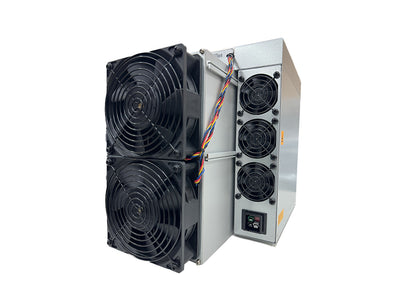
- A miner with an IceRiver KS7 needs a price of at least CZK 0.67 (hosting) or CZK 2.95 (household electricity at CZK 5/kWh) at today's difficulty.
Where the Kaspa price is today
| Indicator (as of 18 Oct 2026) | Value |
|---|---|
| Price | 0,75 Kč (~USD 0.035) |
| All-time high | USD 0.208 (1 Aug 2024) |
| Decline from the high | about −83% |
| Market capitalisation | just under USD 1 billion |
| Coins in circulation | ~27.74 bn KAS out of a maximum of ~28.7 bn |
| New coins per day | ~1.78 m KAS (~USD 62,000 at today's price) |
For comparison: at today's price (1 767 033 Kč) and a supply of just under 21 million BTC, Bitcoin has a market capitalisation of over USD 1.5 trillion, more than 1,500 times that of Kaspa. We explain what Kaspa is and how it works technically in a separate article, Kaspa (KAS).
How to check any prediction
The simplest check is to multiply the predicted price by the number of coins. Since Kaspa's emission is almost complete, you can simply use the maximum supply of about 28.7 billion KAS. You get the market capitalisation the network would need to have at that price.
| Price per 1 KAS | Market capitalisation | For perspective |
|---|---|---|
| USD 0.035 | ~USD 1 bn | today |
| USD 0.10 | ~USD 2.9 bn | just under three times today's value |
| USD 0.208 | ~USD 6 bn | a return to the 2024 high |
| USD 0.50 | ~USD 14.4 bn | 14 times more than today |
| USD 1 | ~USD 28.7 bn | roughly 1/60 of today's Bitcoin |
| USD 150 | ~USD 4.3 trillion | about 2.5 times all of today's Bitcoin |
The last row is no accident. The previous 2024 version of this article took an estimate of USD 149–170 per KAS in 2050 from other websites. Such a figure would mean Kaspa being worth several times more than Bitcoin is today. That is why we removed it from the article.
What public predictions say
For perspective, here are two commonly cited pages, both updated on 18 Oct 2026:
| Source (as of 18 Oct 2026) | 2026 | 2027 | 2030 | Method |
|---|---|---|---|---|
| Changelly | average USD 0.041 | average USD 0.033 | average USD 0.131 | technical analysis (moving averages, price history) |
| CoinDataFlow | USD 0.020–0.033 | USD 0.019–0.055 | USD 0.060–0.274 | indicators + simulation based on Bitcoin cycles; the authors themselves call it experimental |
Two pages with the same date differ almost fivefold for 2030. Both also state explicitly that this is not investment advice. For comparison: the estimates we cited in 2024 for 2026 assumed USD 0.39–0.47. The reality as of 18 Oct 2026 is around USD 0.035, more than ten times less.
What could push the Kaspa price up
- Real use after the Toccata hard fork. Since 30 Jun 2026 the network has supported covenants and ZK proof verification. If applications with users are built on this (tokens, escrow, links to other networks), demand for KAS for fees will grow. You will find details in our news piece Kaspa Toccata hard fork.
- Low inflation. The block reward halves every year. Over the next 12 months, about 0.47 billion KAS will be added, around 1.7% of circulation. A year later it will be half as much again.
- Interest from exchanges and institutions. New listings and regulated products widen the circle of buyers. One sign of interest was an interview with a Kaspa community figure broadcast by the regulated exchange Gemini – but that is not a listing in itself. We write about it in our news piece Gemini turns its attention to Kaspa.
- The overall market. Smaller coins have historically moved with Bitcoin, only more sharply – both up and down.
What could bring the price down
- Technology without users. A finished technical foundation does not mean developers will build on it. The ecosystem may develop slowly.
- Selling pressure from miners. Miners pay for electricity in koruna and dollars, not in KAS. They sell a large part of the new coins – currently about 1.78 million KAS a day.
- A weak crypto market. In downturns, smaller coins usually lose more than Bitcoin.
- Competition and technical problems. Fast networks with smart contracts exist elsewhere too. A bug in the network or exchange problems after an update can shake confidence.
- Manipulation. Artificial “pumps” are common with smaller coins. We describe how to spot them in our article How pump and dump works.
Three scenarios without target numbers
Instead of a specific price, it is more honest to describe what would have to happen and how you would recognise it:
| Scenario | What would have to happen | Signals to watch |
|---|---|---|
| Pessimistic | No usable applications appear after Toccata, the crypto market stays weak, miners keep selling. | Low numbers of transactions and covenant applications, liquidity leaving exchanges, miners leaving (falling hashrate). |
| Middle | The network slowly gains users, and the price moves with the market as a whole. | Gradually rising fees and activity, stable hashrate, new listings. |
| Optimistic | Successful applications are built on Kaspa, and strong growth of the whole market and institutional interest follow. | Rapidly growing network activity, a rising share of fees in miners' income, regulated investment products. |
Even the optimistic scenario has no guaranteed outcome. But the market capitalisation table above shows how big a change any target price would require.
What price a Kaspa miner needs
For miners, the price at which a machine covers its electricity matters more than any prediction. At today's network hashrate (~375 PH/s), 1 TH/s mines about 4.75 KAS a day, which today is 3,55 Kč. An IceRiver KS7 with 30 TH/s and 3,500 W consumption (84 kWh a day) mines about 142 KAS a day.
| Electricity price | Cost per day | KAS price for zero profit |
|---|---|---|
| CZK 1.13/kWh (cheapest hosting) | ~CZK 95 | ~CZK 0.67 |
| USD 0.065/kWh (~CZK 1.40, hosting USA/Finland) | ~CZK 117 | ~CZK 0.83 |
| CZK 5/kWh (Czech household) | CZK 420 | ~CZK 2.95 |
The calculation applies at today's difficulty and does not include the price of the machine. Watch out for emission: the reward will halve within a year. If network hashrate stays the same, roughly double the KAS price will be needed in a year for earnings to stay the same. You will find current figures for specific machines in our ASIC miner profitability table.
How to treat predictions sensibly
- For every prediction, look for the date, author and method. Without them it is just a number.
- Convert the target price into market capitalisation and compare it with Bitcoin or the market as a whole.
- Don't rely on a single source. The difference between two websites is often several-fold.
- Only invest an amount you can afford to lose. The basic rules are covered in our Guide to the world of cryptocurrencies.
- Keep your coins in a wallet whose keys you hold yourself – not on an exchange or in an unknown app.
What next
- Want to understand Kaspa first? Read our overview Kaspa (KAS) covering the algorithm, emission and miners.
- Considering mining instead of buying? Compare the machines in our Kaspa miners collection and electricity prices in hosting.
- To store your coins safely, follow our guide Kaspa wallet.
Sources
Frequently asked questions
Can Kaspa reach 1 dollar?
Are price predictions on websites reliable?
Why has Kaspa fallen so far below its all-time high?
At what price is Kaspa mining still profitable?
Is it better to mine Kaspa or buy it?
This text was prepared with the help of AI. Facts, figures and procedures were checked by Yegor.